by Gemma Ushengewe
English translation by Akimé Habiyambere
English I French
This epic prose poem By Gemma Ushengewe is on the run. BLACK VOICES IN ECHO is a fugitive poem that finds portals of freedom in shadows and resistance in refusal. What fugitive practices are you engaged with?

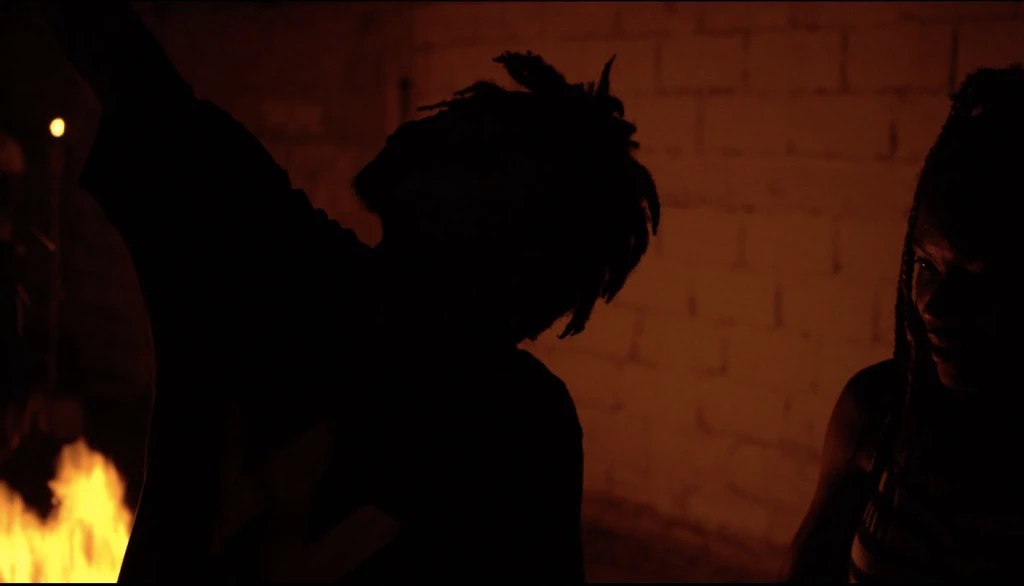
The first text, “Based on the play ‘The Wake'” was read during the presentation of “The Wake” by Olivier Marboeuf and the company The living and the dead ensemble, at Théâtre de l’usine in 2020 in Geneva. Gemma Unshengewe was one of the guests for an artistic intervention at the end of the presentation. The artist read this text accompanied by a display of images from the play.
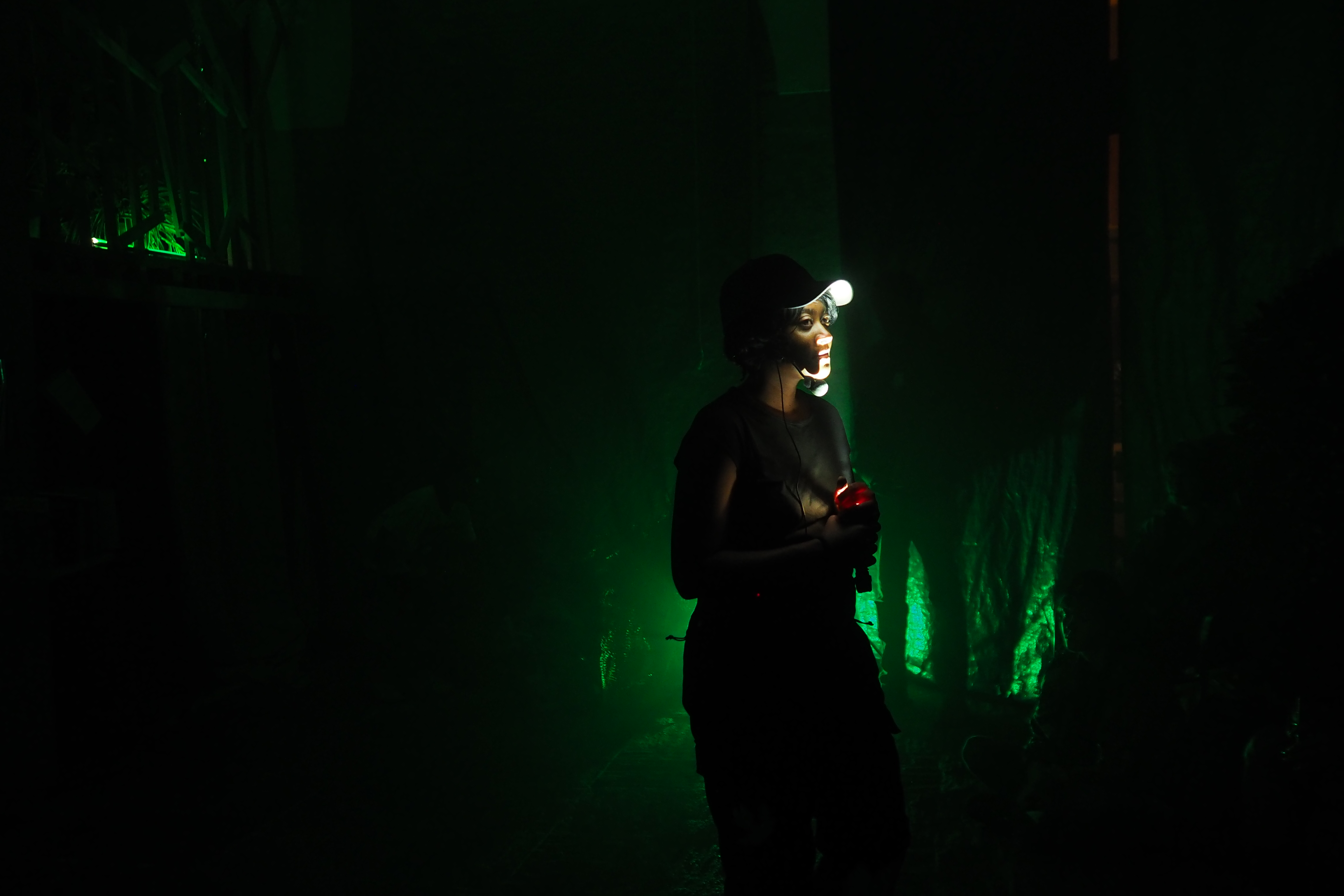
The second text “I am” is a performed text written in 2022. With the help of a torch, the artist opens a field of the imaginary that accentuates the orality of the text. Gemma is inspired by the codes of the Maroon fugitives to invent secret languages and multiple voices that are at once threatening, incantatory and magical.
I. Based on the play “The Wake”
Thank you for inviting me into this circle where the fire has already taken its place. My story is a bit like yours, a bit like ours.
It is the story of this voice that quivers in the “trembling of Earth”. This trembling of the world since the deportation, colonisation, the great social, political and economic cataclysm.
In the middle of these standing, sitting, sometimes lying on the ground as if almost dead, but still breathing bodies:
Fire.
The fire is in the circle,
the circle animates the fire,
the screams are in tune with the crackling of the fire,
these protest signs shelter us around the fire that roars our rage.
What stands out for me in the play “The Wake” is the voice and the multiple voices, polyphonic, polyglot, sometimes coming from beyond to tell the voices of the dead and the survivors.
If I am here today, in fact, it is because I need you. My cinematographic research revolves around the staging of voices, voices that are out of breath, that demand justice and reparation.
In this circle, formed by the waves of multiple geographies, I speak to you about my voice.
Something has happened.
I feel as if I have lost my voice.
After so long, I am now trying to get it out from the head, from the mind, but it stops and evaporates.
My story, I tell it as a scene. A scene in which the White gaze stares at me. This gaze asks me to turn myself in. Turn in my story and my voice.
But I refuse.
The gaze continues to stare at me. It stands there, waiting for something to happen.
The initial narration of this scene was supposed to be like this: that I accept this place so kindly granted by the White gaze. And that I accept to deliver my story. What a provocation to refuse! What a turmoil!
How dare I question the charity of earlier and the reason why this gaze stopped on me. I am called a shameless person, a provocateur.
I then come into conflict with this gaze that has already thought out my role, my place, my word, my voice, my response.
It is the look of a film industry that manufactures representations, that dispossesses and that assigns places.
My vision of cinema conflicts with their cinema. My images must fight against these double images, these generic dolls that have my face. My narrative must escape from a dominant narrative that would like me to empty myself of my substance and become one of these generic dolls.
Now I am looking for other voices that share the same struggle. Voices that sometimes choose silence as protection, screaming as strength, stuttering as a feint, laughter as an escape. I am looking for alliances.
People say to me: “The films you make are communitarian”. Because making films only between Black people would be exclusion? This White gaze, which presents itself as “The” universal gaze, thinks it is the centre from which we observe the horizon. But am I not myself all the points of departure and all the horizon lines?
Or am I the person who is expected to deliver their substance to a dominant gaze? But who benefits from all of this? Who benefits from our experiences as immigrants, children of immigrants, exiles, colonised people, deported people, illegalised workers? From what point of view are our bodies filmed?
When we are filmed in the cinema and we become the subjects of the cinema, we tell them: Black is not the title, Black is not the chapter, Black is not the synopsis. When we are given a place in the production structure and we become the subject of production, we tell them “Black is not my profession”.
Fatigue, weariness, breathlessness, anger, permeate our struggling voices. Voices that sometimes wander and retreat into the mind, into hyper-vigilance, into other strategies to keep themselves alive, under the inequality of the kingdom of speech.
What I’m talking about here is that sense of having been eaten up, sucked in to the point of losing one’s breath and one’s voice—as it says in the play “The Wake”.
There is a need to question the structures of representation. And to re-think even more independent forms of structure. Collective structures where the voice is always desired and shared will.
Let all these bodies and voices form these new structures. Let the voices be present before the opening of the scene, during the scene and in a continuous struggle towards victory. Towards the end of the end.
And now here we are, resisting with all our rage tied up in our throats, our minds heating up and creating democratic follies, democratic syndromes. We breathe fire into each other.
We are in a world of antagonistic forces, of tectonic plates moving in opposite directions, in the midst of imperialist blocs arm wrestling. And if this voice comes out, it is fire! The fire that lights up the whole play “The Wake” and our fire against the capitalist fire.
Our strength is in the meeting of voices, in the resonance of voices and collective resistance.
These voices of struggle speak of desire and alliance!
Sentenced and burned alive at the stake by the colonial power, Mackandal is transformed into a flame of resistance. He is no longer the subject of, he is at the birth of all living kingdoms. Then the people walk with this fire of the torches that illuminate the night of rebellion.
II. I am
I AM the one you cannot catch.
Retrenched in the forest, the vines are my acolytes, you are the one who will stumble.
My words would not bow down to your conventions, my words speak of faith.
I defend myself with my words, you protect yourself with men, their bodies as guards.
Four on him, they could do nothing. Not because he is the strongest, but because his fate is in my words he has fate in my words.
I AM the one who will not be fined for your tactics and annexed lands.
You cannot find me.
I AM in the factory and I share a secret with all your workers. Everywhere there is a risk that the atmospheric meter will explode. I AM behind you, I have been beating you by several turns.
I AM the one who went through customs asking about the wrong direction.
I lurk while you patrol.
I AM the one who is keeping an eye while you are monitoring.
I AM the one who is uniting while you are scattering.
I AM the one who is waiting while you are sorting and counting.
I AM there, watching. From the hill you may hear our laughters, that turn into a scream and torture your mind.
The chant of the survivors is with me. It is true the man suffers and writes songs. These songs of pain caress the scars. They give you hope and freedom in a small gift that is carefully held in your hand.
Song of hope, sorrow song, present song.
“The song is a message, my child, this song is your freedom”, they sing, awakening me to myself.
“Follow the bottle, follow the bottle”, they sing as they lead me north.
I AM like a ghost.
Are you afraid? Because I have seen everything, I have heard everything.
You do not want me to turn against you?
I am not from the outside, I am not from the inside, I am gravitating around in a continuous present past.
Through the forest, the rivers, the sewers, the taverns, the cabarets, the subways of all the cities, I sneak in. I am in every corner. I am the offspring of those whom you could not kill, and who come back to hold you accountable. You will not get me. Our stars are in orbit, chasing each other. Our force of attraction pushes at the conjuncture.
Let the words and speech be with me. Words can make everything vibrate higher. They can defuse everything.
They are free. They were always free.
Speech is as fast as light. Speech is the truth of your own consciousness.
I AM on this train, you stop in front of me, you ask me for my route; you seek to ensure my legality.
You ask me to prove my identity.
In this train, I am the one who decides my trajectory. I am the one who goes around the earth, I am the sun. It is not written on my papers; it is not revealed.
I AM in your predatory sights, I have the profile of the villain, you portray me in your discourse, you tag me, you want me, I unfollow you. My escape endangers your popularity and influence.
Racial profiling on trains, station platforms, at bus stops, in waiting and emergency rooms. Racist violence trivialised, a selection that became natural, elimination, extreme ease of pulling the trigger, no hesitation.
Here you lose your innocence
Here you are no longer a child
Here they treat you like a prisoner
Here you get up before the sun
And you wonder if the sun is real
Here you stay or you go, but it is not you who decides.
One hour to go to sleep, one hour to shower, one hour to eat. A single delay and it’s a whole day of hunger. Weeks, months, years of waiting for a response on deportation or citizenship.
Suspended times where you try not to go crazy. But you are not allowed to go crazy. If you do go mad, they lock you up. They put fences on your window, cages on the stairs, surveillance cameras, nowhere to escape.
A decade later, I come back to this place.
Nothing has changed—the building is still here, the same fences around the centre.
I lurk around and I watch from a road as the guards monitor. I pass by the newcomers, suitcases in hand, on their first day at the center.
“I don’t know how long I have to stay here”, says one of them to me.
Time is a cycle, empires are a cycle, but my words are eternal.
About the Black Voices Matter series
Black liberation is both beautiful and inspiring. It is equally noisy, infused with the hubbub of online discussions, hashtags and commentaries from the media, institutions and those economic and political leaders who have, until now, paid very little attention to the well-being of Black lives. In this context, ERIF has chosen to continue—now more than ever—to care for and cultivate the multilingual and diasporic frequencies of Black voices. #BlackVoicesMatter

ERIF’s Black Voices Matter series has been sponsored by the European Network Against Racism (ENAR) 2021 National Project Grant Scheme.
 erifonline.org