by Cindy Sissokho
English I French
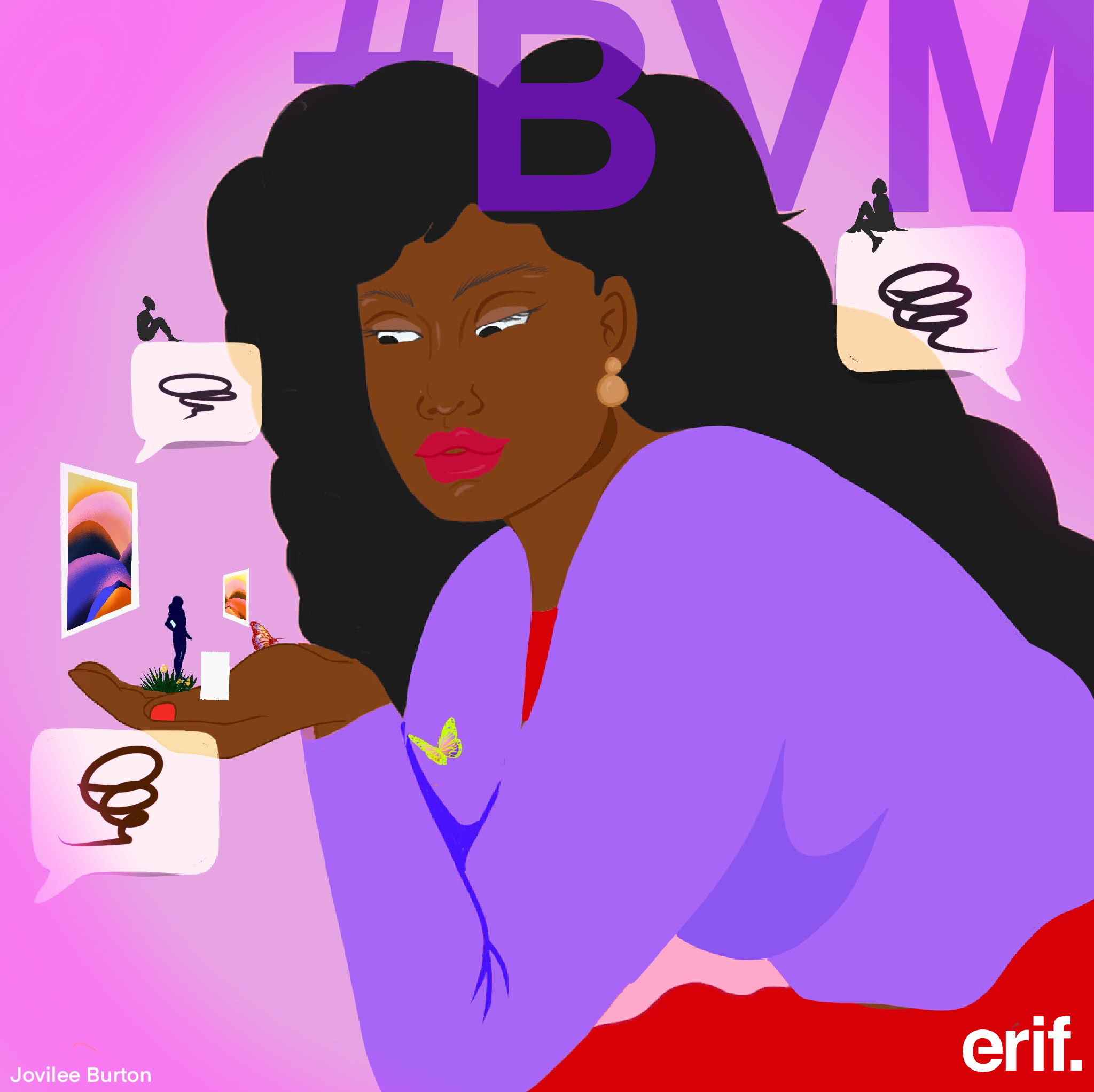
Black curatorial practices are portals to otherwise. That’s the bold proposition of this reflective piece written by Cindy Sissokho which proposes the possibilities of curation as a mode of liberatory spacemaking. #BlackVoicesMatter
What are the new or non-languages stemming from Blackness?
//
How do we create an architectural space of spiritual presence?
\\
What characterises a curatorial practice stemming from a place of margin(s)?
//
What does it mean to employ the practice of curation to seek liberation, self-actualisation and a space to politically reflect on the world, as a Black woman?
Defining curatorial worlds

Image of details from one of Rachel Jones’ paintings in her exhibition SMIIILLLLEEEE at Thaddaeus Ropac in London in 2022. Photo credit: Cindy Sissokho.
I have called myself a curator.
I insist on using the word curator, as curateur-ice and not the usage of the word commissaire in the French language — one that deeply connects with the highest rank of the police, meaning state authority, historical and ongoing institutional racism and violence on Black/racialised bodies. I have asked myself how a Black woman can associate with this term? as I was on the journey of understanding how I belong to the practice(s) of curating.
And thus, I have embraced calling myself a curator, but also a cultural producer, a writer and at times an art consultant. My predominant practices revolve around artistic development, mentoring, and collective collaborations such as jury panels or artist’s portfolio reviews. I did not study and invest in the educational institution of curating. My entry into the world of curating was born out of the practice as a form of personal and collective pedagogical tool, one that is intimate and instinctive with curating, one that nurtures artistic kinships and deep admiration for the latter to be disseminated generously and widely.
I understood the power of artistic practices and the architectures that hold them to influence culture, entering the realm of performing the political. Spaces that were built on exclusion and hegemonic narratives. The practice of curating continues to exclude a multiplicity of voices and narratives, it refuses to engage with an epistemic diversity, it reproduces stereotypes shaping neoliberal and fascist alliances as aesthetics for propaganda. There are ongoing discussions to have had to deconstruct the effects that the curated exhibition(s) has shaped within the field of Culture and consequently the field of Politics, and the notion of Citizenship and the Nation-State.
I enter those discussions with a sense of duty for what creative spaces and dialogues had to offer when thinking of curating as a pedagogical and political tool. Other terms to describe this could be a practice of assembling, breathing, connecting, dismantling, counter-storytelling, improvising and building from the many cultural grounds that have become possible today.
I look up to the work of Okwui Enwezor (1963-2019) and Bisi Silva (1962-2019), amongst other past and present figures for paving the way for our future. I/we live through them in the verbal, visual and written archive of their lives that remains ever so present. I came to realise the many possibilities of liberation and self and collective expression that are at stake in the contemporary art world, and beyond, thanks to them.
This short reflective piece of writing was developed with the intention of:
— sharing words
— a stream of consciousness
— instances of thoughts
to archive autobiographical words within the temporality of 2022/2023. They represent some of the current thoughts and personal observations within curatorial practices/contemporary art with a specific attention on the transnational resonances that are taking place within grassroots and institutional initiatives by/for Black people today. It is a personal mapping exercise; it is a genealogy of thoughts, of what I think is currently taking place.
Curating and the politicisation of Black life

Image of one of Frida Orupabo’s works in the exhibition of Deutsche Börse Photography Foundation Prize at The Photographer’s Gallery in London in April 2023. Photo credit: Cindy Sissokho.
My path as a Black woman curator navigating between languages and national spaces has led me to apprehend curatorial (and artistic) practices as multidisciplinary methods to denounce, criticise and make visible ongoing issues and a way to reinforce the politicisation of Black life. I refer to the word curatorial to designate the multiplicity of methodologies, tools and practices brought together in the aim of articulating new narratives, points of reflections in a diversity of formats that is experienced and deeply felt by individuals and collective entities. The cathartic and affective experience of the physical, digital, discursive curatorial proposal populates collective imaginaries, assembles new thoughts, leaves an effect on the psyche that drives change. The artist plays a role in conveying new formulations of hope and an accessibility to concepts through aesthetics.
Curating is a form and mechanism that produces ongoing knowledge that lives beyond the experience of the receiver(s) with its fixed and final content. As curators, we have to ask ourselves: what are the substances we wish to leave visitors with? Black curatorial practices are essential in forming communities of distinct knowledge and a portal of uncontrollable, organic and new articulations outside of the fixed physical environment of the exhibition it is located in. It is an urgent call to dismantle the status quo and to shape new territories of resistance and joy when curating, albeit alone or collectively.
A curatorial practice that is a radical practice continues to be hopeful towards social and political change in the modes of connectivity, enhancement of understanding local and international urgencies and acting against and outside of institutional racism and discrimination the sector inhabits. I nurture curatorial practices that have the possibility to step outside of exhibition-making and that are not only determined by conventional gallery spaces but by a plurality of exchanges and formats. Curating as Black is a Black (radical) practice when a full ownership of creative agency is gained to activate change within/outside hegemonic narratives. Curating becomes a tool of resistance, of interdependencies, of the construction and dissemination of political dialogues and the articulation of imaginary narratives.
In my childhood dreams of adulthood, my imagination didn’t take me as far as the contemporary art spaces as they were so removed from the complexity of everyday life. However, the arts became the portal that has allowed me to carve new realities and a new emotional landscape to escape my familiar environment. The artistic field was indirectly transmitted to me through family transgenerational love for and through the practice of music: from soul to R’N’B, from hip hop to jazz and from electronic landscapes to mbalax. This sonic transmission came through in the experimentation and approach that I have today with visual arts drawn to visceral, rhythmic connections, and an astute interest in forms and movements borrowing sonic languages, from music came literature and from literature came an appreciation of languages.
Self-cartography

Image of the Blk Art Group archival display in the exhibition The Place is Here at Nottingham Contemporary in Nottingham 2017. Photo credit: Andy Keate.
With this background, antiracist anticolonial epistemologies were commonplace to me growing up in Montreuil in Seine-Saint-Denis in the suburbs of Paris. However they were not valued, seen or approached as knowledge systems when stuck within French identity politics obsessed with assimilation into the (white) Republican model. I did not acknowledge at the time, nor had the words and theoretical concepts to understand that my located history and upbringing was connected to broader histories of a long tradition of Black radical resistance. Indeed, there was a dear lack of references of anticolonial and colonial narratives within the national school curriculum in France. I/we grew up lied to, blinded and shadowed from histories of resistance. My years at university were the starting point of an independent and self-taught curriculum in parallel to studying Communication and Cultural Mediation in Paris 8 in Saint-Denis.
Whereas the French continental context was marked by a taboo of anything pertaining to race, my critical intellectual growth around the politics of race predominantly took place in England. I moved there when I was 21, and became exposed to discourses on racial politics stemming from and inspired by the 1980s Black Arts Movement and the rise of Cultural Studies, both of which were (and are) flourishing in the UK, i.e., outside of the imperialist US context. Moreover, these developments were essential in shaping arts and culture ecologies, where Black artists paved the way for generations to come—including me, today. Those generations have witnessed artistic production as an active tool to denounce the nation-state, they have reclaimed certain institutional spaces and created their own cultural spaces — they have articulated what can be made possible as a Black artist to manifest existence. These manifestations were part of a lineage of political and artistic statements that I have witnessed either literary or physically, such as: Thin Black Lines curated by artist Lubaina Himid at Tate Britain in 2011, the ongoing work by the collective Blk Art Group shaped by artists Eddie Chambers, Dominic Dawes, Lubaina Himid, Claudette Johnson, Wenda Leslie, Ian Palmer, Keith Piper, Donald Rodney, Marlene Smith. These artists have also created archival platforms and organisations such as Making Histories Visible, the Black Cultural Archives, iniva and Autograph.
Another important site of knowledge was the production of spaces and discourses by racialized voices through ongoing writings and publication of texts in contemporary art journals such as Third Text founded by artist and writer Rasheed Araeen. The journal documented the shifts in artistic practices and culture across times, and still does today. These references are a nutshell of what nourished me and opened up for me in terms of new conceptions, and later on, arenas of production. These references made me acknowledge the lack of connections I had and could find in the French context. They continue to be an inspiration for generations of (Black) creative practitioners.
Institutional performance

Image of Museums series in the exhibition The Evidence of Things Not Seen by Carrie Mae Weems at the Württembergischer Kunstverein in Stuttgart in 2022. Photo credit: Cindy Sissokho.
In the most recent years, a decolonial turn shook the entire contemporary art world. My use of the term “decolonial turn” echoes here the Puerto Rican philosopher Nelson Maldonado-Torres who used the term to describe the wave of initiatives and practices that have gathered around the notion of epistemic diversity, decoloniality within institutions and political life. From my perspective within the art world, I would say that the decolonial turn also can refer to the global anti-racism demonstrations of the summer of 2020 and the problematic wakeup call by individuals and institutions in posting black squares on social media, anti-racist statements as a demonstration of interest and care by the art world (and beyond) for Black life.
Initially emerging through the battles of the oppressed and racialised subjects, decoloniality became commodified and institutionalised, it became the status quo within institutional life leading to the visibility of performative gestures and the diminishing of political agencies from liberal activism. The contemporary art world has adopted liberal politics in which reflections of the reality become a background noise to draw inspiration from, for their advantage and on their terms, namely on terms that connect with funders’ agendas and privilege the production of trends tied up with art markets.
The ongoing waves of ‘diversity’ or ‘diversity and inclusion’ agendas through governmental funding streams have strongly influenced the ways in which Black and Brown representation needs to be portrayed, talked about and engaged within institutions and more broadly within the arts and culture sector through exhibitions, projects, symposiums. The DEI waves have had an impact on the visibility of racialised artists, but have too often taken place within spaces of contradiction. By this, I refer to the institutions that have historically refused, neglected or excluded the visibility and narratives by racialised practitioners within their programming, but have more recently, and somewhat insincerely, shifted to the imposition of liberal politics of representation in these spaces. Spaces of contradiction meaning that practices and gestures of engagement have been non-committed in the long term.
I believe the responsibility of the arts is to spontaneously respond to current events, in the tradition of carrying politics through aesthetics, as long as it is genuinely embedded, and not only with the aim of satisfying funder’s agendas. Unfortunately, the art market has mainly followed the institutional tradition and trends of showing and selling artistic practices that have tightly connected with what and who generates profit.
Decoloniality in the French context, taking me back home

Image taken in Transplantation’s reading room as part of the exhibition Diaspora At Home at KADIST in Paris in 2022. Photo credit: Cindy Sissokho.
In the French context/language, a resurgence of radical writing and artistic practices have risen. The latter have allowed me to create further connections and identification of the specificities of racialised voices on the French soil, and therefore importantly drawing from untranslatable experiences of home. These essential knowledge productions developed a renaissance of contemporary critical discourses that have come to trouble white universalist understanding of identity and shed light on the blindspots of cultural institutions. For example, the works of scholar Maboula Soumahoro , scholar Mame-Fatou Niang, writer Fatima Daas and writer and scholar Kaoutar Harchi, with specific critical engagement, through the words, and within arts, culture and the understanding of identity. I also have admiration for the brilliant work of curator and writer Amandine Nana and the ongoing development and fight for her project Transplantation Gallery, which finds nodes of survival through collaborations in spite of the scarcity of spaces and funds.
The work of these radical thinkers, curators, and writers continues to resonate beyond the hostilities of hegemonic worlds and articulate marginalised experiences. Indeed, France currently does not make space nor allow for physical Black spaces. Despite all the emulation in the French landscape, the efforts in building spaces of collective debate and emancipation stemming from racialized voices remain non-sustainable due to governmental funding cuts. Consequently, the few existing spaces undergo slow asphyxiation — they are no longer able to breathe and survive. Funders’ agendas decide how, what and who remains visible.
Beside the UK and France, I seek and continue to be nurtured by Global South transformative epistemologies and (re)turning the gaze towards other horizons of reasons. What does it mean to work within a space where Blackness is status quo? and where the visibility of racialised bodies does not function as a measure of how ‘diverse and alternative’ a project is.
Making (curatorial) politics: when the mothertongue is no longer mine

Image of details of Julien Creuzet’s sculpture in the exhibition The Possessed of Pigalle or The Tragedy of King Christophe at High Art in Paris in February 2023. Photo credit: Cindy Sissokho.
Language has shifted throughout history, and its layered construction and usages have either oppressed or liberated. The ongoing evolution and/or instrumentalisation of language across curatorial practice means a reclaiming of concepts such as anticolonial, decolonial or intersectional, and has meant a constant linguistic re-evaluation to distinguish or join forces with certain practices, permanently or on specific occasions when creating Black space(s). In my case, the French language continues to condemn identitarian self-expression to a non-existent void until reading lived experiences through others, as mentioned in the above reflection. The English language, somehow, allowed for me the expansion of terms, vocabulary and concepts fabricated in relation to Black life. However, it is through the visual language of artistic creation that I was allowed other facets of cathartic resonance with my experience echoing with others. Artistic practices articulate the words that were no longer available onto unknown experiences. Curatorial practices create the space in which this visual and sensory vocabulary came to life and continues to do so.
//
Today, I aim to seek and attempt an answer of what is yet to remain,
be built in order to continue to create
and imagine other places,
spaces
and languages through curatorial practice that is liberating, countering hegemony,
therefore dismantling
and building anew.
Parallel readings
Fatima Daas, The Last One. Other Press, 2021.
Kaoutar Harchi, I have only one language, and it is not mine: a struggle for recognition. Liverpool University Press, 2021.
Kaoutar Harchi, Comme Nous Existons. Actes Sud, 2021.
Gaye Theresa Johnson, Alex Lubin, Futures of Black Radicalism. Verso, 2017.
Olivier Marboeuf, Suite Décoloniales: S’enfuir de la Plantation. Éditions du Commun, 2022.
Katherine McKittrick, Demonic Grounds: Black Women and the Cartographies of Struggle. Minnesota Press, 2006.
Maboula Soumahoro, Black is the Journey, Africana the Name. Polity, September 2021.
Tina C. Campt, A Black Gaze: Artists Changing How We See. MIT Press, 2021.
Tina C. Campt, Listening to Images, Duke University Press, 2017.
Saidiya Hartman, Wayward Lives, Beautiful Experiments: Intimate Histories of Social Upheaval, W. W. Norton & Company, 2019.
Robert Farris Thompson, Flash of the Spirit: African and Afro-American Art and Philosophy, 1984.
Souleymane Bachir Diagne, L’Encre des Savants: Réflexion sur la philosophie africaine, 2013.
Cheikh Anta Diop, The African Origin of Civilization: Myth or Reality, 1974.
Cheikh Anta Diop, Precolonial Black Africa: A Comparative Study of the Political and Social Systems of Europe and Black Africa, from Antiquity to the Formation of Mod, 1988.
Leda Martins, lecture performance Performances of Spiral Time, 2003.
Paul Gilroy, The Black Atlantic: The Modernity and Double Consciousness, 1995.
Homi K. Bhabha, The Location of Culture, 1994.
Shades of Black: Assembling Black Arts in 1980s Britain by David A. Bailey et al, 2005.
and many more.
About the Black Voices Matter series
Black liberation is both beautiful and inspiring. It is equally noisy, infused with the hubbub of online discussions, hashtags and commentaries from the media, institutions and those economic and political leaders who have, until now, paid very little attention to the well-being of Black lives. In this context, ERIF has chosen to continue—now more than ever—to care for and cultivate the multilingual and diasporic frequencies of Black voices. #BlackVoicesMatter

ERIF’s Black Voices Matter series has been sponsored by the European Network Against Racism (ENAR) 2021 National Project Grant Scheme.
 erifonline.org