by James Yuca
English I German
Speaking of her peers from a prestigious art school in the Netherlands, James Yuca observes “They had their own ‘cool guy’ disruptor plans and no real need for community space”. Evoking her attempts to create a more politicized way of doing and organizing artwork via the collective beuys bois, James’ vulnerable and yet hopeful essay draws out the exploitative, impatient nature of art spaces and communities, which could both instead be nurturing and supportive by centering queer of colour artists’ needs and views.
Lately I’ve been so full of love. I tell myself, there is too much to lose. Every person I meet that contributes to the struggle of liberation becomes a bounce in my step.
A former teacher of mine once told me: “If art is too political it is no longer art”. Because it came from his mouth, I was expected to receive it with open hands, on my knees. His art was clean, accompanying text with at least three philosophical concepts, juxtaposed with some natural element as if winking toward the world we’ve left behind. “Man” is central, the engineer, the solver, the conduit between chaos and order. His art is functional, the goal is to cause confusion and bring about questions; his job is to suggest contemplation. His “cool guy disruptor” art spits in the face of the notion that art has to serve a message or function beyond art itself.
And I get it—art for the sake of art, separating the practice and theories from function liberates the maker from the deadlock of artist as social worker, artist as governmental mouthpiece, artwork as highly publishable solution for a problem that’s systemic. Bringing about questions about overlap between art and everyday life is nothing to sniff at, but it requires a financial and social wealth I do not possess. In my experience there isn’t a way for me to make art without conjuring questions about my gender, ethnicity and origins even if it is not the subject of the work. My existence is political, my survival is political, my art is political.
Bel Kerkhoff-Parnell approached me a few years ago to write about starting an art collective called beuys bois, a community centre called The House and the network that has kept me from sleeping on the streets. Thanks my faggots, trannies and traitors—I couldn’t have done it without you.

Studio portrait of James Yuca, 2018.
The royal pain in my lower middle class ass
It is no secret that the Royal Academy of Art (KABK), a well-known and respected institution in The Hague, has a history of employing sexist, racist and classist teachers. In the last two years, three educators were fired from the Fine Arts department for serious misconduct such as abuse of power and sexual harassment, for example taking photos of the crotches of women without their consent. I started at the academy in 2018 and dropped out at the beginning of my third year because of chronic health issues. In my time, there was no continually-employed woman-identified teacher or person of colour that could assist with my journey in Caribbean ancestry and the effects of colonialism on institutional power dynamics. There were no books on Surinamese artists, nor lectures on Caribbean art. The school’s response to my legitimate complaint about the lack of diversity in our lectures was to encourage me to form a group, select themes and prepare and perform lectures for free. The lecturer who made such a suggestion did not see this as exploitation; actually, I think he felt he was offering me an opportunity. He was not the only elderly privileged man who thought himself exceptionally generous for offering me a chance to serve their personal agenda.
While teachers at the Sculpture department pushed me to look inward, my findings were so far removed from their frame of reference that their feedback seldomnly applied to my practice. I understood that these people would be the audience I was destined to cater to if I followed in their footsteps of gallery shows, museums, art fairs and prestige. They encouraged me to stay inside, work my craft, contemplate existence, emerge to share my findings then return to solitude with new information. While I have no issue with this style of creating, I understood that sharing my findings with this audience was not going to help my exploration inward; sharing my art in that institutional context felt alienating and belittling.
I was receiving invites from festivals, exhibition spaces and established institutions thanks to my connections in the field, but all of these opportunities involved exploitation of my identity as a queer person of colour. There is nothing wrong with institutions celebrating diversity or uplifting minorities, and I think in many ways the impulse to give complex intersectional identities a stage can lead to more acceptance. Most institutions know that inclusivity and diversity are desirable values and, in 2018, there were no shortage of events or exhibitions that reflected that. While showcasing people of colour as subject isn’t a new practice, institutions could now harvest the benefits of appearing engaged and sympathetic to the plight of minorities without making any substantial changes to their staff, distribution of funds or mission statement. Most often, I was expected to perform my identity in a very specific way without expecting financial compensation.

Opening of the migration museum, September 22nd, 2018. Standing in front of an ink landscape. Photo by Remco Osorio Lobato.
In the image above, I am in blackface performing the role of the exotic other; every visitor was greeted by me without saying a word. I carried a small ceramic instrument called an Udu which I played continuously except when offering visitors the opportunity to play the instrument themselves. Very few hesitated to participate, only some had to be persuaded. When the visitor produced a sound through the Udu, they’d be “blessed” with a bit of my black paint on their forehead. Most wide-eyed stares belonged to people of colour, who were also performing or helping. In my mind the exchange was not optional, just as a visitor would relax after politely declining, I popped up, haunting them with pleading eyes and relying on their white guilt to give into my demand. I became a parody of a person and dragged others along. After all, didn’t you come to see the clown at the circus? Did you not desire evidence of your interaction with the savage?
All my efforts left me empty and more isolated than before. Not only were the ways I performed criticism such an insufficient threat to the shape of any institution that I was invited to protest. Worst of alI, I was still an individual prostituting my identity for the sake of a career. I was sick of returning to my work space with nothing but exhaustion and disillusion.
Money, Honey
In 2019, Narges Mohammadi was appointed by Het Zuiderstrandtheater (now known as Amare) as organizer of the event Queering The Church. I was a last minute addition to the full programme she composed with a wide definition of “queer”; that evening the church echoed with performances strange and sexual. Narges took me seriously as an artist and participant even though I was a real pain in her ass. I asked each participant what their motivation was to take part if there wasn’t monetary compensation for anyone but the more well-known artists. I didn’t mean to target Narges, I was upset with another institution whose interest in the marginalized and underpaid did not reach beyond socially acceptable exploitation. The complete disregard for the financial struggle of minorities was especially egregious from a well-funded organization. At this point in my life, I had just upgraded from sleeping on a mattress on the living room floor of a friend and spent my weekends working a backbreaking kitchen job to help afford rent and my full time study.
I hadn’t expected that other creators would turn to Narges and question her budgeting decisions during the very last stage of putting on the event. I naively thought that if participants signed on knowing they wouldn’t be paid, it would be a bit of a silly move to demand some cash anyway. Narges paid everyone by redistributing her own curator fee and laid out her choices in an email for the sake of transparency. Her ability to listen, respond through action while being vulnerable and generous at once won my absolute respect. Deeply embarrassed by my unintentional in-fighting, I decided it was time to switch course and instead of dissecting, questioning and protesting alone, Narges and I started building a case for a queer art and community house together.
The Hang Out 070 had existed for about five years by then, a non-profit organization run by queer people of colour and focused on queer people of colour despite very little budget and no permanent space. We’d been introduced by an organization called Stroom, which mediates between artists and the municipality, as well as advising and facilitating public works. Narges and I would apply art theory proposals to secure a permanent location for queer people of colour to gather and organize, and The Hang Out 070 was going to co-sign lending us their credibility. For the municipality this was a win: two groups with similar needs at the same venue with the potential to bring in funds from the social as well as the art sector.
After six months of visiting existing archives, familiarizing ourselves with the international queer art collectives, meeting with supportive Stroom employees, receiving feedback on the seven different versions of our proposal for a community centre-art house hybrid, meeting with the municipality and building a relationship with members of The Hang Out, we received the keys to our new home, “The House”, in 2020.

Event “Ruben was reading erotica” featuring Ruben on the bar in the community centre before renovations in 2020. Photo by Ayla Aron, currently known as James Yuca, for beuys bois.
Narges was in her graduating year and I spent most of my days in pain or fatigued, beuys bois grew to include graphic designer Kexin Hao, Flora van Dulleman and an art archivist Natalia Nikoniuk. While from different departments, at that time all members were KABK students. Our school had no classes on how to handle the financial or professional aspect of art making; every member of beuys bois had to be taught a crash course in applying to funds and writing proposals, formal emails, making budgets, finding relevant documents, making notes and leading meetings.
A faggot and their friends between zoom calls

Aya Koné modeling beuys bois collection in 2020. Photo by Flora van Dullemen for beuys bois.
We all know how quickly the world changed once the COVID-19 pandemic took hold; all of our wild fundraising plans suddenly had to be adjusted to suit social distancing while also rewriting concepts we had for organizations such as Nest. After the initial wait for the crisis to clear, we focused on fundraising by crafting a fashion collection to sell bearing the logo Kexin made. In hindsight this was my favourite era, as we spent hours together working with our hands, hopeful about the future of our collective. Unfortunately this proved to be an ineffective way of fundraising, very time and energy consuming while our audience of art students and queers rarely had the funds to buy what we made.

Toto Stoffels and Daniel Walton modeling beuys bois merchandise in 2020. Photo by Flora van Dullemen for beuys bois.
The world reopened in 2021 and we dove head first into collaborations and expanding the groups making use of The House.

(L to R) Natalia Nikoniuk and James Yuca of beuys bois, Elsbeth Dekker and Robbie Schweiger of SuperFlus, Babi Badalov in 2021. Photo by Naomi Moonlion for beuys bois.
The art collective Superflus from Amsterdam approached beuys bois for a collaboration. We facilitated space for a flag making workshop led by Babi Badalov and Superflus would finance the plans we had to archive or enrich the event. It was the first time we had strangers and friends in our centre to work on something other than the space itself. We were paid for our efforts and could contribute to bills as promised. By now Riyaz van Wegberg, sole coordinator of The Hang Out, would approach us wild eyed from time to time to check on our financial and legal progress.
The municipality was evicting all organizations making use of the building called De Samenscholing in favour of office buildings in the middle of suburbia. One of those organizations, De Opstand, is an anarchist organization which had programmes such as a free shop, gym sessions for queer folks, a library and hosted events such as a queer prom or information exchanges about hormone replacement therapy. I met one of the most active organizers, Joey, the summer we reopened The House during a fine barbeque session hosted by The Hang Out. Because beuys bois wasn’t generating money consistently I thought it wise to open up the space to more organizations. De Opstand moved in their library where it remains to this day.
At this point Narges left to pursue her solo career, we’d gained and lost several members and I was worn beyond reason. The project I had undertaken to foster community had completely lost that aspect. I was haunted by the financial burden of keeping the space open and the interpersonal issues that pop up when organizing together. It did not help that I had been illegally evicted by one former beuys bois colleague and was about to be evicted by another. In my quest for a space for community, I had ironically become homeless twice over.
I announced my hiatus in September 2022, and by October beuys bois was disbanded. We’d existed for less than a year and had not even begun to reach for the bigger funds. Over time the quest for a space for community had become an immense pressure; one of the members complained our project was no fun. Overall I am most disappointed that it was incredibly hard to integrate the art school students with the existing Hang Out community, and by the time I left beuys bois most members were white with plans to leave the country. They had their own cool guy disruptor plans and no real need for community space. Just like my teacher they were not scared to be isolated or homeless, their economic and social power insulated them from living on the streets.
I on the other hand slept on couches of friends like Joey, in beds of lovers, squatting in a building for months on end and ended up living in an established squat with people from De Opstand. My survival depends on community, on queers, on the capacity to create and persuade.
About the Black Voices Matter series
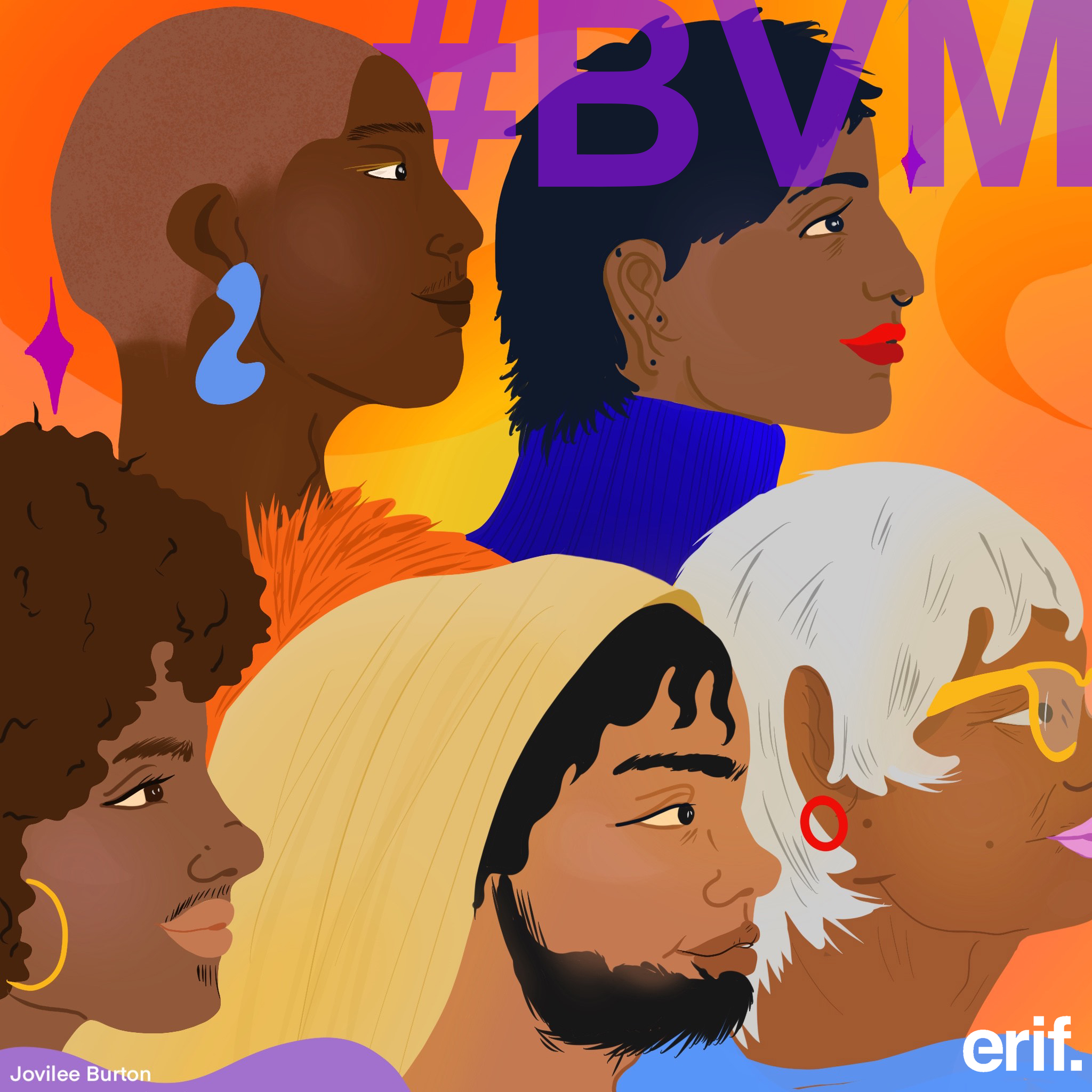
Black liberation is both beautiful and inspiring. It is equally noisy, infused with the hubbub of online discussions, hashtags and commentaries from the media, institutions and those economic and political leaders who have, until now, paid very little attention to the well-being of Black lives. In this context, ERIF has chosen to continue—now more than ever—to care for and cultivate the multilingual and diasporic frequencies of Black voices. #BlackVoicesMatter

ERIF’s Black Voices Matter series has been sponsored by the European Network Against Racism (ENAR) 2021 National Project Grant Scheme.
 erifonline.org