DEUTSCH | NEDERLANDS | FRANÇAISE
The ERIF Sinterklaas Brand and Product study was launched in 2015 in order to evaluate how different (Dutch) shops and brands depict and market the Zwarte Piet character. Sinterklaas is one of the most popular festivals in the Netherlands and, in terms of active promotion and consumption, lasts for roughly six weeks each year. The festival celebrates and reveres Saint Nicholas, but is contemporarily removed from its religious roots in favour of centring gift-giving and collective feasting. Marketed primarily at children, celebrations are found across all private and public (commercial) sectors and domains of life, making it impossible to completely avoid or ignore. We began this research in response to parents and teachers at our first conference, who expressed concern about the impact the Zwarte Piet character (a caricature of an enslaved Black man) would have long-term—not only on Black children, but all children—in terms of them learning about racial dynamics and structures. The study has followed, recorded and analysed the evolution of Sinterklaas merchandise and marketing, using online quantitative data collection, complemented by qualitative in-store observations across the country. Our key aim has been to find a way to track the transformation of the character from a commerce perspective, as well as explore its contemporary role in the festival, in relation to the ongoing discourse and discord on racist imagery. Thus, this longitudinal research can be considered as both social market research, but also an archive of the anti-racism activism that has taken place in the Netherlands over the last decade, since our reports illustrate the year-on-year cultural—and subsequent commercial—shifts taking place in response to these campaigns.
Alongside the valorisation of the precious and essential anti-racist campaign work that has been undertaken in response to Dutch Afrophobic violence, ERIF’s reports also contribute to furthering contemporary scholarship of Dutch history, cultures and traditions; colonial histories and legacies of consumption, wealth and marketing; as well as to scholarship around racism, identity, belonging and social justice movements. Relatedly, this year-on-year study can be positioned amongst discourses that place race as both a force of oppression and resistance in various marketplace contexts. Furthermore, as this report brings together 10 years of research, in honour of the 10th anniversary of our first conference on European blackface (November 2014), the full report also offers accounts of present-day blackface from other parts of Europe, including Spain and Switzerland. In this way, we continue the conversation and exploration of what this specific, pernicious form of anti-Black racism means to communities and anti-racist campaigners a decade later.
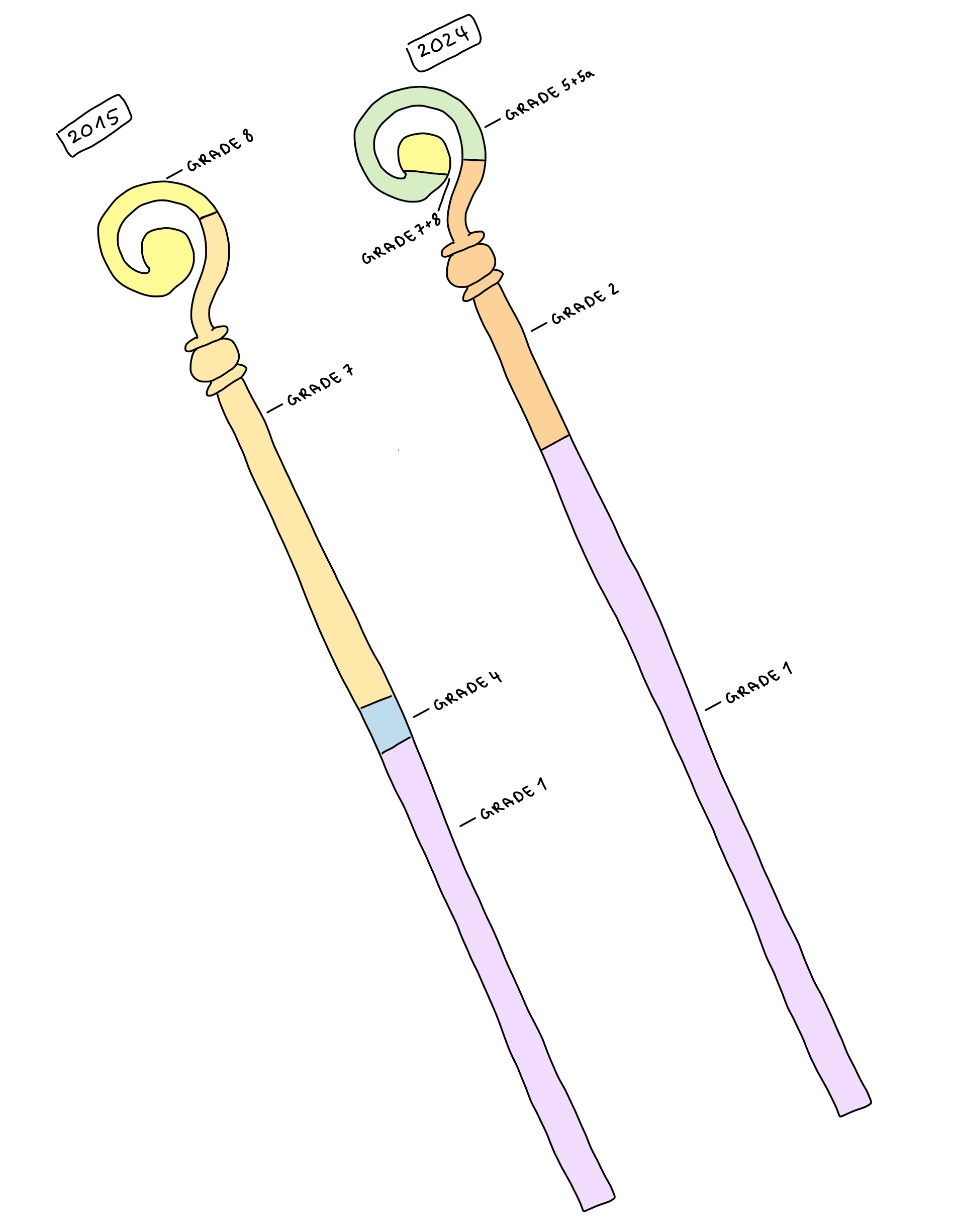
Movement of key grade share 2015 vs. 2024. Illustration by Louisa Chioma Edekobi.
Summary of key findings in 2025
Blackface and Gatekeeping Belonging is ERIF’s 10th brand and product study. Pulling together the results from our most recent research period (winter 2024, alongside those from the previous results, we are able to demonstrate sustained collective and individual resistance and advocacy against the use of blackface during Sinterklaas over the past decade has ensured the (mainstream) presence of Zwarte Piet is diminished. To summarise the main concrete results from this year’s report:
- Sinterklaas products with no reference to the Piet character at all have grown to over 50% of the total market share;
- Vague and “sneaky” references to Piet (with outlines, shadows or “hidden” Piets) are still more significant and present on packaging than the official roetveeg (sooty) Piets;
- According to our historical data, at its peak the most dehumanising and mocking Zwarte Piet imagery accounted for over 50% of market share. This shrunk to less than 5% by 2024;
- On the other hand, observational accounts show that Zwarte Piet is still present and traceable in-store and/or via smaller, privately run businesses beyond the scope of our quantitative research, which complicates the online results’ narrative and makes us question how much commercial and societal influence prominent brands and stores actually have—as we explore further in the report itself;
- Overall, while significant shifts have been recorded, Sinterklaas merchandise and marketing continues to traffic racially-driven and discriminatory imagery and rhetoric, which risks exposing children to white-cis-het male supremacist stratification systems from infancy.
Read the full report here, and contact ERIF with any questions via info@erifonline.org.
This summary is also available in Dutch, German and French (see top of this page).
About ERIF
Founded in 2013, the European Race and Imagery Foundation (ERIF) aims to re-imagine a more inclusive Europe. We expose and criticize dominant narratives of belonging and racist imagery and amplify stories of resistance and liberation. All our activities seek to remedy how mainstream anti-racism neglects the histories, views and creativity of racially minoritized peoples—especially Black people. In this perspective, ERIF produces events (conferences and workshops), social media campaigns (e.g., our Quotes of Resistance campaigns), online content (blog posts and toolkits) and research projects and publications (e.g., the annual Sinterklaas report; a special issue for Darkmatter journal about blackface in Europe), with the aim of magnifying, connecting across countries and facilitating the accessibility of anti-racism efforts by activists, scholars, artists and residents.
 erifonline.org