by Bel Kerkhoff-Parnell
English I French
The personal is political. Couched in the intimacy of a letter to a friend Bel Kerkhoff-Parnell tenderly walks through the landscape of her life tugging at the varying entanglements of Blackness, womanhood and motherhood.
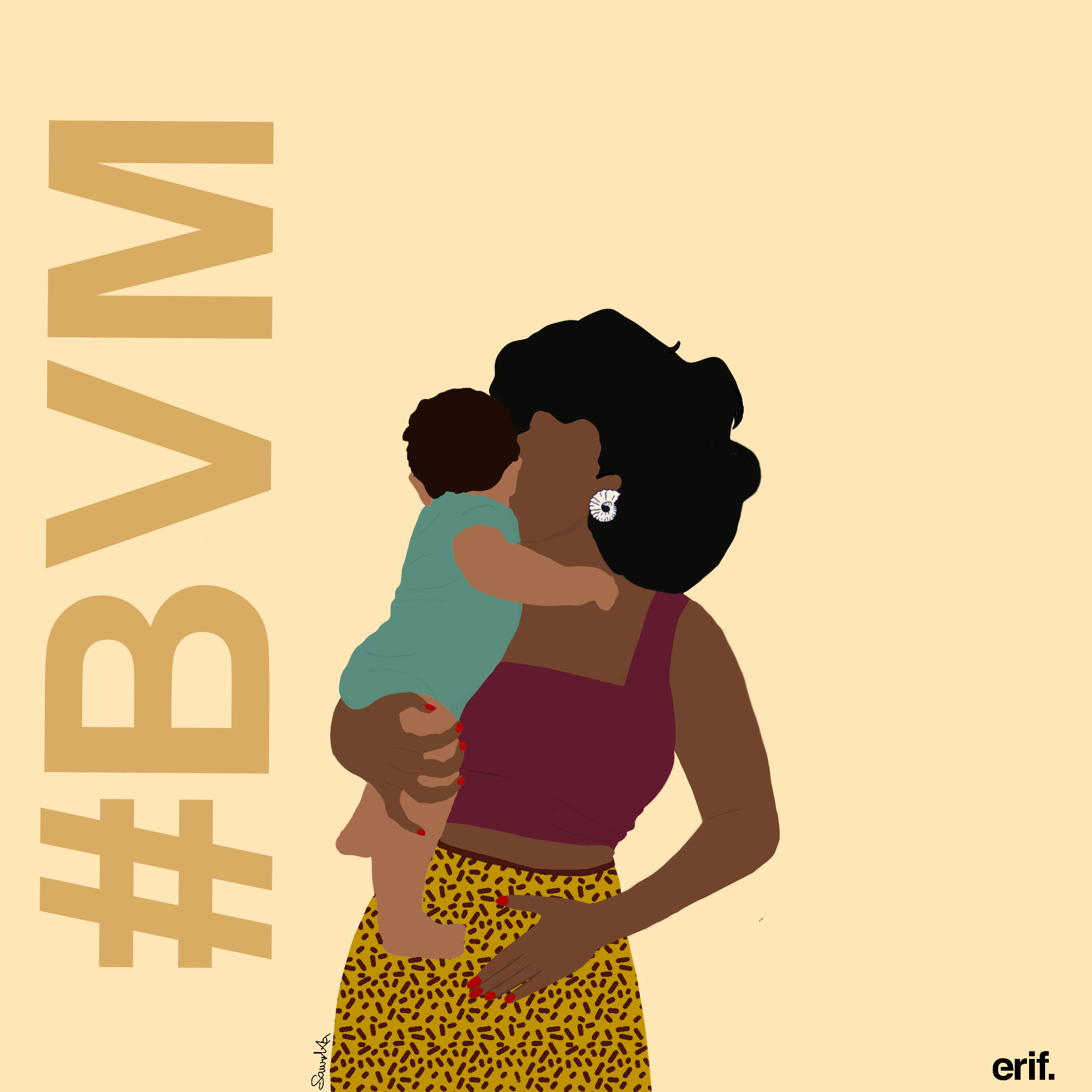
Den Haag, October 2021
Dear Noémi,
How are you? It’s been a while since you first got in touch with me about writing this essay, and a lot has happened since then. I think back to the summer of 2020, when we spent a lot of time chatting and WhatsApping about our frustrations with the mainstream mediatic coverage of the BLM movement, and you expressed the importance for us to initiate our own narratives. This of course was a fantastic idea, very much in tune with our key vision as members of the European Race and Imagery Foundation (ERIF), and with time it evolved into this project—a new online publications series entitled: #BlackVoicesMatter—where you sent me and others prompts to get the discussions going. Thank you for sending me a wonderful and thoughtful list of topics and questions for the series, and for your patience while I marinated on these prompts. Responding to you, via this letter, really helped me to organise my thoughts on life, generally, over the past couple of years. It might be a bit of a cliché to say that the writing process has been cathartic, but it genuinely was a relieving and healing exercise; I especially have cherished the collaborative and supportive aspects of this project, as they very much tap into my increased engagement and respect for Black feminism rooted in community, as well as life-sustaining scholarship and praxis.
2020-2021: a politics of exhaustion and grief
Returning back in January 2021 to the work of anti-racist campaigning and scholarship at ERIF—as well as paid work in the Dutch university and editorial sectors—following half a year of maternity leave, my mind was somewhat overwhelmed and cluttered. As much as I was looking forward to working with you again, and as much as I wanted to quickly engage with your questions, it was difficult for me to formulate any kind of response. As you know, my background is very diasporic: my mother and sister are in the UK, my father and brothers are in the US and I live in the Netherlands with my Dutch husband and children. Thus, as I recapture some of my emotions when I returned to work and received your call to contribute to the series, it’s important to note that at that time I had not seen my mother and sister for a year. It had been even longer since I last saw my father and brothers. The global outbreak of COVID-19, with all of its intricacies, risks and restrictions added an elevated level of stress and worry to most people’s lives. Typical dysfunctions aside, in times of great stress and trauma we gravitate to the familiar—to home and relatives—for comfort. COVID-19 took many lives, but also because of travel bans, gone was the possibility of finding solace with our loved ones, whether they lived near or far.
Before 2020, I had taken for granted—even celebrated—the geographic distances between me and my family. By January 2021, I had never been more homesick. It wasn’t only pandemic-based travel bans that made me long for home, though. In late May 2020, I heard the story of an African American man from Minneapolis—George Floyd. He was very tall and, like my Dad and brothers, had played basketball in high school. He had children and grandchildren, and had been an influential community leader. But then his life was cut short and that moment seemed to change the lives of everyone around me.
I don’t know what made me more angry: the way George Floyd was killed or the fact that George Floyd had to die for people to start waking up to the very obvious racism around them. I was already furious and grieving about the murders of Breonna Taylor and Ahmaud Arbery, and to be honest so many others as well. The morbid fascinations of certain individuals and media outlets about the details of Black people’s deaths would make me sick, and the double standards applied in looking for fault with the victim without very much interrogation of the murderer(s) at all would make me prickle with rage. Mostly, I would long to hold all of my relatives close and tell them I loved them, that it would be OK, to find a way to keep us all safe and to have some sort of answer for my own children about why the world is like this.
Thus, finding out about yet another white supremacist execution of an African American was so taxing. I very much felt a constant exposure to anger, sorrow and grief. I will admit that initially the unified response of outrage, as well as the demand for change, was inspiring and gave me some hope—especially as the calls for justice globalized, leading to a European reckoning with regards to racism and police brutality. However, Chantelle Lewis notes the “symbolic violence caused by a white awakening to systemic racism” during this period, characterising the summer of 2020 as “exhausting, confusing, scary, and hopeful all at the same time”. It was only too true that this mainstream response to US police brutality was much delayed, and might not have come at all if half the world weren’t forced to sit still, constantly on their phones, waiting out the end of a public health crisis.
This might seem cynical, but where are the widespread calls now? Already a “fatigue” regarding conversations around anti-racism—often dismissed as “wokism” appears to have set in, which is disappointing even if it isn’t altogether surprising. For example, I think back to Keir Starmer (current leader of the British Labour Party) diminishing Black Lives Matter as a mere “moment”, as well as his dismissal of calls to defund the police and address police brutality, by distancing racism in the UK from similar issues in the US. This was just weeks after Starmer perfomatively posed for pictures taking the knee. Additionally, Luc Sels of KU Leuven in Belgium opened the 2021-22 academic year by cautioning against “cancel culture and woke movements”, even hinting that such stances within teaching and research would not be tolerated. The same Sels and the university went on to host an event honouring the 1968 “Black power” demonstration of olympians Tommie Smith and John Carlos, just one month later. Frustratingly, these examples illustrate what we’ve always known: the powers that be are comfortable enough to wag a finger at racist events and structures in the US. Conveniently though, leaders such as Starmer and Sels are not prepared to address our own European issues with ethnic profiling, racist violence and police brutality, and are even vocally critical of those of us working towards that. I have found bringing proper attention to discrimination and racism in the UK (and now the Netherlands) to be an enormous challenge since becoming involved in anti-racist campaigning and scholarship.
Children and the police
One day over the summer in 2020, I went to pick up my son from playschool. At the intersection of the playschool, there had been a fatal traffic accident and the police were taping off the area. This obviously diverted traffic, but also meant that pedestrians could no longer easily cross the road. I suddenly felt this strange wave of panic that if I were to cross the road in front of the police, so close to the taped-off area, I would draw attention to myself and be questioned. I considered walking back up the road in the other direction to cross elsewhere, but I didn’t want to be late collecting my son. Eventually, a stream of (white) people just began crossing the road, so I followed their path and…nothing happened. I picked up my son and we went home and had a lovely afternoon. I wasn’t aware of how the frequent reports of Black people being harassed and brutalised at the hands of the police had impacted me, because I’ve been fortunate enough to have hardly any interactions with them myself. Thus, it was the first time I realised I’d been living with a deep-seated anxiety around the police that could arise at any moment. It should not have been a surprise that I had pushed my own personal, emotional reactions so far below the surface, given how often we face denial from others regarding racism.
Following this non-encounter, I reflected on a brief interaction with the police from when I was a child, visiting family in Alabama. I was with my cousin Darlene as she was stopped by the police while driving. To me, her interaction with the police officer seemed fairly unremarkable. However, as soon as we got back to my aunt’s house the adults discussed the incident frantically, showing me—at a very young age—that any form of contact with the police was a very serious affair. Moreover, because I observed this occurrence at such a young age, I have never felt at ease with the overwhelmingly disproportionate attention paid to the police brutality directed towards Black cis-het-men, versus Black (trans) women and non-binary individuals, as well as children! Despite mountains of statistical data and social research observations showing us how all African-descended people are dehumanised and then brutalised, within our own communities we tend to disregard issues affecting women and children as less important or urgent. This asymmetry of attention rooted in ageism and sexism is something that I’ve become increasingly invested in better understanding and exploring, especially since our first ERIF conference Returning the Gaze: Blackface in Europe. The most important knowledge I came away with was the insistence by parents, carers and teachers of children, that the young are not only very much aware about racialised socio-politics, but they are resilient enough to also engage critically with this subject matter—as shown by Ancestors UnKnown’s powerful work. I therefore find it evermore crucial to invest in intersectional strategies and frameworks to guide children in critical racial media literacies.
Mothering and anti-racism
You asked me how being a mother played out in my anti-racism. Since I became a mother years ago, in addition to thinking about how to help our kids interrogate and articulate racism, I have also spent more time following the critical discourse around how Black pregnant people (BPP) and their un/newborn babies are treated in the UK and the Netherlands. BPP and babies’ lives are put in danger due to racist discrimination at alarming rates within healthcare, as has been discussed on BBC Radio 4’s Woman’s Hour show in 2019, written about in detail by Dutch midwife Pia Sophia for Dipsaus and as chronicled by Black Ballad throughout their week-long Huffington Post UK takeover series. I was shocked to learn that BPP are four times more likely to die in childbirth for example, and to hear numerous stories of blatant discriminatory behaviour on the part of health professionals. Alana Helberg-Proctor’s research has shown that racism in Dutch medicine, whether or not deliberate, is nonetheless pernicious—i.e., victims might not even realise they’re being targeted until after the fact, which is something I can really relate to.
Moreover, I have had other experiences over the past few years that illustrate how beyond healthcare, strictly speaking, I experienced a lack of care in professional and social circles that I navigate. I witnessed how BPP and post-natal parents are still not given much room to rest, adjust and nurture in the months—or even weeks—after giving birth. It was painful for me to realise that there was an almost universal expectation for me to immediately be available professionally. In one situation, a former colleague who was aware that my due date was approaching asked me to contribute to an unpaid project that would take place mere weeks after I was to give birth. In another scenario, a colleague actually called me during maternity leave and demanded to have a conversation about a work matter, even after I reminded her I was on leave and—at that precise moment—caring for my infant daughter. The colleague insisted I take her call anyhow. More generally, I’ve been to conferences visibly heavily pregnant and been expected to participate in hours-long activities while standing and without breaks. And upon returning to work, I observed that there is very little compassion for parents who wish to nurse or express milk across most professional spaces. These examples tie into the common—and dehumanising—notion of the “strong Black woman”. Ironically, that misguided notion of Black resilience and endurance actually makes us, Black women, so much more vulnerable when being pregnant, giving birth and mothering.
Navigating racism in education
Furthermore, it’s been frightening to learn just how deep-seated racism in schools continues to be, not just in terms of discipline but also grading and secondary school advice—particularly in the Netherlands. This is something that we, as a family, are currently trying to navigate, and gently guide our son through.
As a mother, I’m still figuring out what to make of it, and how to guide my children properly. I’ve been thinking and writing a lot recently, about how I can raise both of my children to be aware of their exposure to forms of racist threats (e.g., either discrimination by teachers or bullying from other children), at the same time as leading joyful, confident lives. I don’t want my children to be hampered by a necessity to behave in a specific way within institutional settings; I have no desire to expose them to respectability politics. I would love for them to be able to just enjoy their educations, to explore different interests, talents and skills and not be afraid to make mistakes or feel pressured to over-perform. These are some of the preoccupations I wish I had been spared during my own childhood. Nevertheless, children of colour being profiled on the street and in the classroom based on stereotypical ideas of Black people is a real risk. I’m trying my best to find the right balance in explaining to especially my older child, how he might be perceived in the world and how he can navigate that himself, while also trying not to make him too self-conscious. I have heard about this tension a lot over the years, as I became increasingly more involved in anti-racist scholarship and activism, specifically while doing fieldwork around the Sinterklaas celebrations in the Netherlands and organising our 2014 conference. I often think back to the presentations by Kahya Engler (recaptured in our published conversation with her and Darren Chetty), and Joana Rubin as mothers. However, honestly, I could not truly comprehend the point parents were trying to make until I became a mother myself, even as I would organise events specifically for and with parents! For instance, one thing I am writing about in my forthcoming book about navigating racism as a parent is the Sinterklaas festival and our participation in it as a family. Before I became a parent, it was too easy for me to dismiss parents who did not like the holiday but allowed their children to participate so that they wouldn’t be “left out” at school. I found this weak and my husband and I vowed we would never follow that path. But taking your child away from something that literally everyone else is doing is not as easy as it looks.
Inspirations for thinking and practising liberation
This letter could have been much longer! But it has already been many months since I promised to come back to you, so I will conclude by responding to your last question on my current inspirations for “actualizing the long tradition of Black liberatory and anti-colonial struggle”. These days, I find myself returning more and more to Anandi Ramamurthy’s Imperial Persuaders where she explains how colonial categories that still inform our identities were formed through the lens of commerce and advertising. This writing is inspiring, especially at this time of year, when Black bodies are rendered even more consumable than usual during Sinterklaas in the Netherlands, when grown men and women parade around in blackface. Ramamurthy’s work has been essential reading for me to develop our ongoing Sinterklaas research, where we chronicle and analyse the evolution of the blackfaced Zwarte Piet caricature on and in Dutch advertising and packaging year-on-year. Thinking about the personal toll conducting this research has taken on me over the past decade, your work on Black accounts of vulnerability and how they can expose the wounds caused by racism is especially important to me. I also love the implicit dialogue between your Darkmatter article with a recent paper by Francesca Sobande and Jaleesa Renee Wells, as both texts handle with care the loneliness for Black women within academia, and the subsequent need for community and partnerships that not only manifest in knowledge production, but also very real support systems.
Gloria Wekker’s masterful entanglement of fragility and privilege for her White Innocence provides a theoretical framework for my book project. Besides the important thematic observations, I discovered through reading this book that her scavenger methodological approach is one I often made use of without realising (e.g., traditional critical discourse analysis applied to various forms of pop culture media viewed as material cultural artefacts). This made me realise that our methodologies—often mislabelled as indisciplined by mainstream academia—are indeed part of a long and broad tradition of Black feminist praxis and scholarship. To that end, Audre Lorde’s enduring essay “The Transformation of Silence into Language and Action” is one I return to in times of procrastination. I hear the essay’s clear and simple refrain: “Your silence will not protect you”, as not only a warning from those who came before us, but as wisdom we should thread throughout our own work in order to pass onto those coming up next to and after us.
Indeed, our collective ERIF’s initiation began imbued with two questions that Lorde herself poses in the essay: “What words do you not yet have? What do you need to say?” I feel more urgently now than ever that faced with the risk of further marginalisation and silencing, we need to continue to ask those questions, not only among ourselves but also to those looking to us for guidance.
With much love and solidarity,
Bel
About the Black Voices Matter series
Black liberation is both beautiful and inspiring. It is equally noisy, infused with the hubbub of online discussions, hashtags and commentaries from the media, institutions and those economic and political leaders who have, until now, paid very little attention to the well-being of Black lives. In this context, ERIF has chosen to continue—now more than ever—to care for and cultivate the multilingual and diasporic frequencies of Black voices. #BlackVoicesMatter

ERIF’s Black Voices Matter series has been sponsored by the European Network Against Racism (ENAR) 2021 National Project Grant Scheme.

